
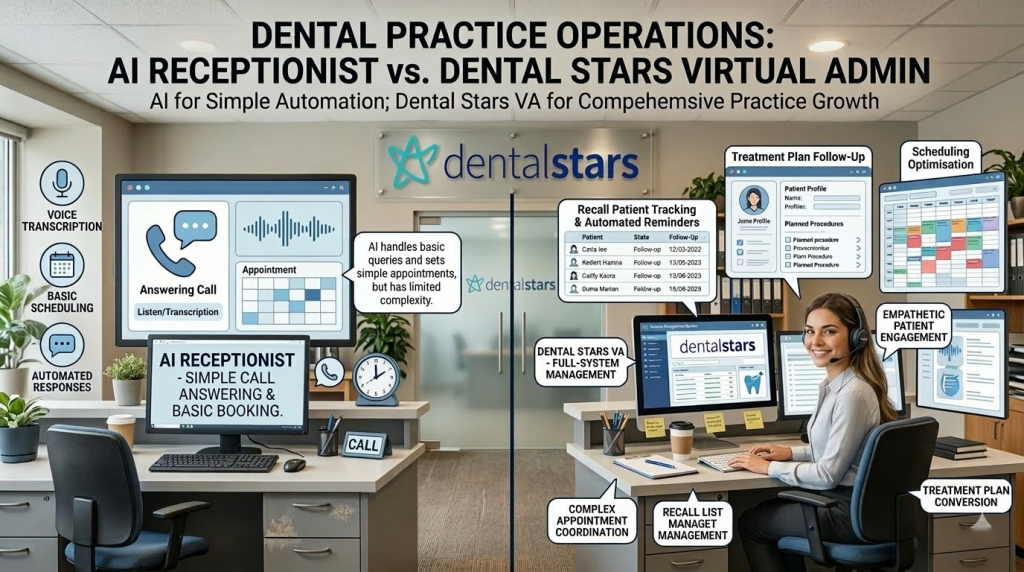
Every week, another AI receptionist platform lands in a dental practice owner’s inbox promising to answer every call, book appointments around the clock, and basically run your front desk for a fraction of the cost of a human.
And look, we get why it’s tempting. Staffing is hard right now. Wages are up. Your front desk team is stretched. The last thing you need is another missed call that turns into a missed new patient.
But before you hand your phones over to a bot, there’s a more important question to answer. Is call volume actually the thing holding your practice back?
Because in our experience working with Australian dental practices, it usually isn’t.
Should You Use an AI Receptionist in a Dental Practice?
In most dental practices, an AI receptionist can help with simple, low risk tasks such as after hours call capture and basic patient enquiries. However, it should not replace human judgement in areas like emergency triage, treatment follow up, recall reactivation, or complex scheduling.
For many Australian dental practices, stronger administrative systems deliver better long term results than front desk automation alone.
This guide explains how AI receptionist software works, where it can help, where it creates operational risk, and what actually stabilises dental practice performance.
What an AI Receptionist Actually Does
Let’s be clear about what you’re getting. AI receptionist software uses speech recognition and pre programmed decision trees to handle inbound calls. It can confirm appointments, answer basic questions, take messages after hours, and in some cases, book directly into your practice management software.
It’s a transaction tool. It’s designed to handle predictable, simple interactions consistently.
That’s actually fine for what it is. The problem is what it isn’t.
Where AI Can Genuinely Help
We’re not here to write off the technology entirely. There are real use cases where an AI receptionist adds value.
After hours call capture
When your doors are closed and someone just needs to know your opening hours or grab a booking link, AI handles that well. Better a message captured than a call lost to voicemail nobody checks.
Repetitive enquiries
Location, parking, general policies, standard appointment types. If someone wants to know if you’re open on Saturdays, AI can answer that faster than your front desk coordinator while she’s managing a patient check in.
The keyword there is predictable. AI performs well when there’s nothing to interpret. It’s when interpretation is required that things get messy.
Where It Gets Risky for Dental Practices
Here’s the reality of what dental front desks actually manage every single day.
A patient calling about a swollen cheek that might be urgent or might not
A nervous patient who needs to feel reassured before they’ll book
A family trying to coordinate three appointments across two calendars
A treatment plan follow up where the real objection is cost, not scheduling
An overdue recall patient who needs a reason to come back, not just a reminder
None of that is a transaction. All of it requires judgement, clinical awareness, and genuine human connection. AI doesn’t have any of those things.
Emergency triage is the big one. “My tooth is a bit uncomfortable” could mean a lot of things. A trained dental administrator working within proper triage protocols will clarify symptoms, check recent treatment notes, assess urgency, and allocate chair time accordingly. An AI system maps keywords to appointment categories. If it misclassifies an urgent presentation, you’re not just dealing with a patient experience issue. You are looking at delayed care, schedule chaos, and a trust problem that’s hard to recover from.
Scheduling distortion is the quiet killer. AI books based on predefined categories. Dental scheduling is far more nuanced. Procedure time, clinician preferences, hygiene flow, staged treatment visibility, outstanding items. If just two appointments per day get misallocated, that’s close to 500 misallocated appointments across a year. The downstream effect on chair utilisation, appointment overruns, and team stress is significant.
The Bigger Problem: AI Doesn’t Fix Your System
This is what most of the AI receptionist marketing conveniently glosses over.
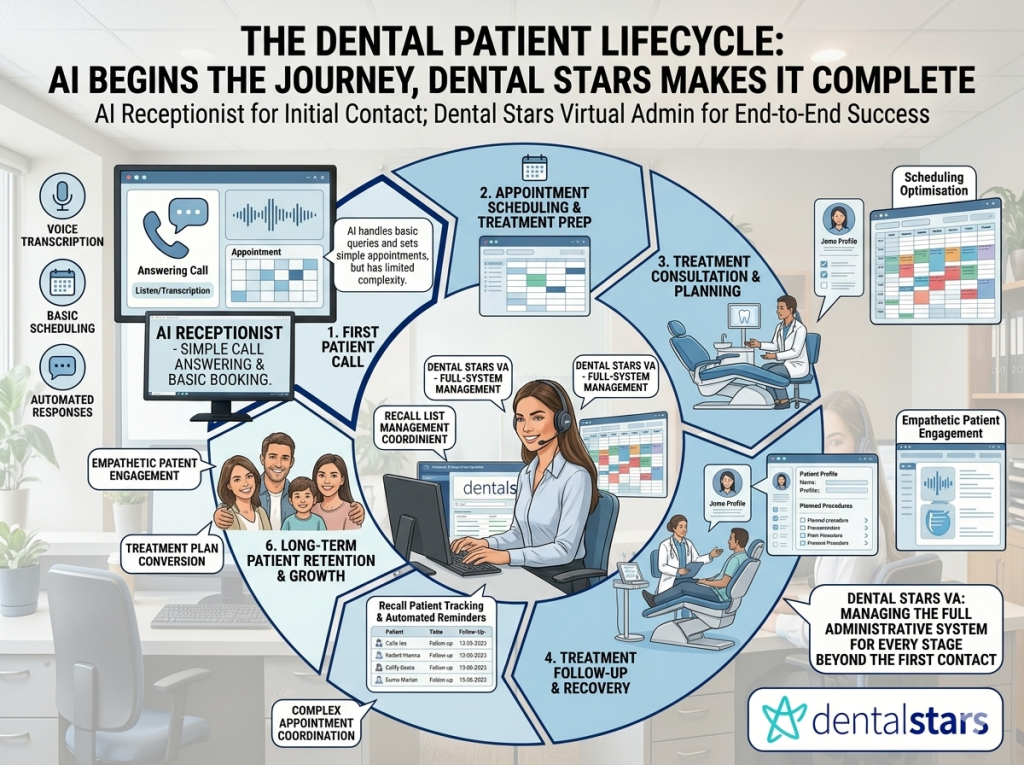
An AI receptionist operates at first contact only. The phone rings, the interaction happens, it ends.
But a well run dental practice needs support across the entire patient lifecycle.
First contact and new patient conversion
Scheduling that actually protects clinical flow
Treatment follow up for plans that stall
Recall management that rebuilds relationships, not just sends reminders
Reactivation of patients who’ve gone quiet
Answering more calls doesn’t recover incomplete treatment. It doesn’t stabilise a patchy book. It doesn’t re engage a patient who’s been avoiding booking their crown for six months.
If your practice is experiencing full days followed by quiet ones, recall drift, or treatment plans that never seem to close, adding automation to your front desk won’t solve any of that. It will just mean more calls get answered before they hit the same broken system.
What Actually Moves the Needle
The practices we work with that have the most consistent, profitable schedules aren’t the ones with the most technology. They’re the ones with the strongest administrative infrastructure.
That means:
Inbound and outbound call management that converts, not just answers
Emergency triage protocols with real clinical awareness
Treatment follow up that addresses hesitation and rebuilds urgency
Recall systems that track, re engage, and coordinate, not just remind
Scheduling aligned to clinical templates so the book stays tight
That’s not software. That’s a structured, system driven approach to the entire patient journey.
AI Receptionist vs Human Administrative Support
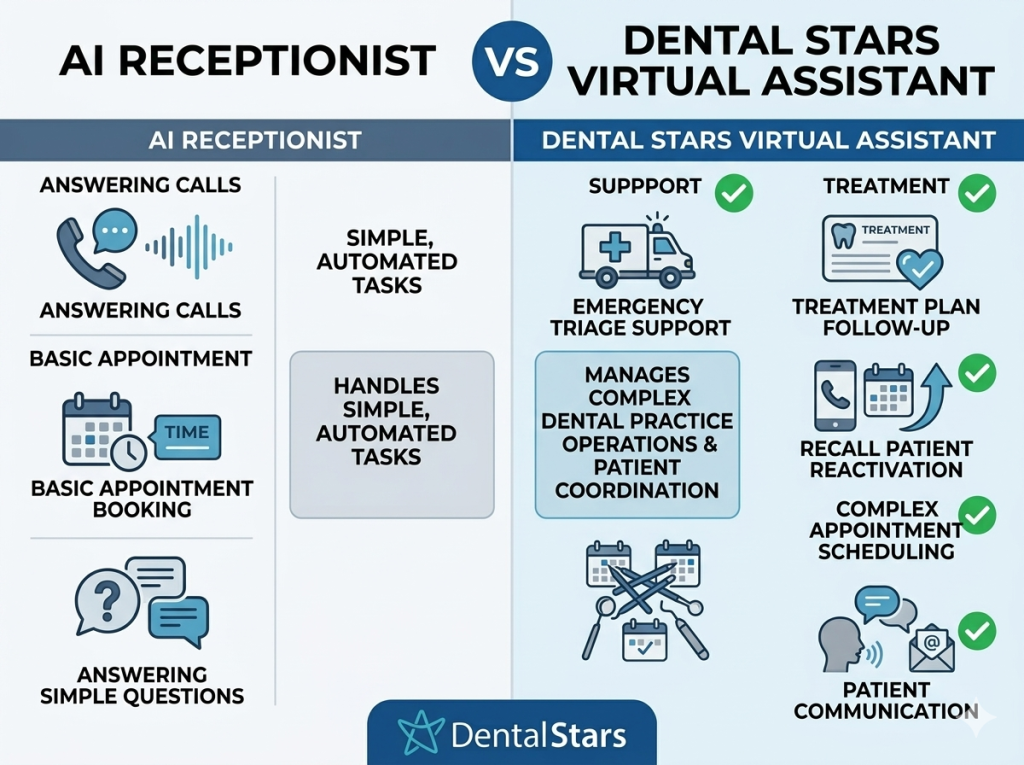
| Function | AI Receptionist | Human Administrative Support |
| After hours call capture | Strong | Strong |
| Basic FAQs | Strong | Strong |
| Emergency triage | Weak | Strong |
| Treatment follow up | Weak | Strong |
| Recall reactivation | Weak | Strong |
| Complex scheduling | Weak | Strong |
| Patient reassurance | Weak | Strong |
| Clinical judgement | None | Essential |
For most dental practices, the real decision is not whether AI can answer the phone. It is whether your patient journey depends on judgement, scheduling accuracy, follow up discipline, and trust.
In those areas, structured human administrative support remains critical.
How Dental Practices Should Evaluate AI Receptionist Tools
If you’re considering AI receptionist software for your dental practice, it helps to evaluate the technology in the context of your current administrative systems.
Ask questions such as:
- Are missed calls actually the primary issue in the practice
• Is the schedule stable and correctly allocated
• Are treatment plans being completed consistently
• Are recall patients returning on time
• Is the team struggling with administrative workload
In many cases, the issue is not answering calls. It is the structure of the administrative systems behind the phone.
Understanding where the real constraint sits helps practices avoid solving the wrong problem.
So Should You Use an AI Receptionist?
Maybe, for specific low risk tasks where the limitation doesn’t create operational problems.
After hours call capture and basic FAQs can work well.
Emergency triage, treatment follow up, and recall reactivation should remain human driven.
The more valuable question before implementing any new tool is this.
Where is your system actually breaking down?
If your front desk feels stretched, your schedule is inconsistent, or your treatment acceptance rate isn’t where it should be, the fix isn’t faster call answering. It is stronger infrastructure.
That’s what we do at Dental Stars. We work with Australian dental practices to strengthen admin infrastructure across the full patient lifecycle, from the first call through to treatment completion and long term retention.
Not Sure Whether Your Practice Needs AI or Better Systems?
If you’re considering an AI receptionist because your front desk feels stretched, your schedule is inconsistent, or treatment plans are sitting incomplete, it may be worth pausing before adding more technology.
In many dental practices, the real issue is not answering more calls. It is the structure of the administrative systems behind the phone.
When scheduling logic, treatment follow up, recall management, and patient coordination are properly aligned, the entire practice becomes more stable. The schedule tightens. Treatment acceptance improves. Administrative pressure drops.
At Dental Stars, we help Australian dental practices strengthen administrative infrastructure across the entire patient lifecycle. That includes front desk workflows, emergency triage protocols, treatment follow up systems, recall reactivation processes, and scheduling aligned to clinical templates.
If you want clarity on whether your next step should be automation or stronger administrative systems, start the conversation here:
https://dentalstars.com.au/book-your-consultation/
Often the biggest improvements in stability and profitability do not come from adding more software, but from building stronger systems behind the patient journey.
Stop guessing. Start fixing what’s actually holding your practice back.
Book a consultation with Dental Stars and get clarity on whether you need automation or stronger systems so you can stabilise your schedule, improve treatment acceptance, and reduce admin pressure.
Not sure if you need AI or better systems? Speak with our team and get a clear answer based on your practice not guesswork.
FAQs: AI Receptionists for Dental Practices
Are AI receptionists cheaper than hiring staff?
The software subscription usually is, yes. But if misclassified emergencies, scheduling errors, and failed treatment follow ups cost you production, that saving disappears fast. The real comparison isn’t subscription cost vs wages. It is operational impact.
Can AI safely handle emergency calls?
No. AI can recognise keywords, but it can’t assess symptom severity, review treatment history, or apply clinical judgement. Emergency triage needs human interpretation and proper protocols.
Will AI reduce my missed calls?
Likely, yes. But reducing missed calls doesn’t automatically fix recall drift, incomplete treatment, or scheduling instability. Answering the phone is step one. What happens next is what drives growth.
Is AI receptionist software AHPRA compliant?
AI follows scripts. The compliance responsibility stays with you as the practice owner. Healthcare communication requires accountable judgement within professional boundaries. Scripts can’t substitute for that.
What’s the alternative?
Structured administrative support that covers the full patient lifecycle. Overflow call management, triage within proper protocols, treatment follow up systems, recall reactivation, and schedule alignment with your clinical workflows.
How do I know if I need automation or better systems?
If you’re seeing patchy books, untouched treatment plans, recall gaps, or admin pressure despite your marketing working, it’s almost always a systems issue, not a call volume issue. Clarity comes from reviewing your infrastructure, not adding software.