
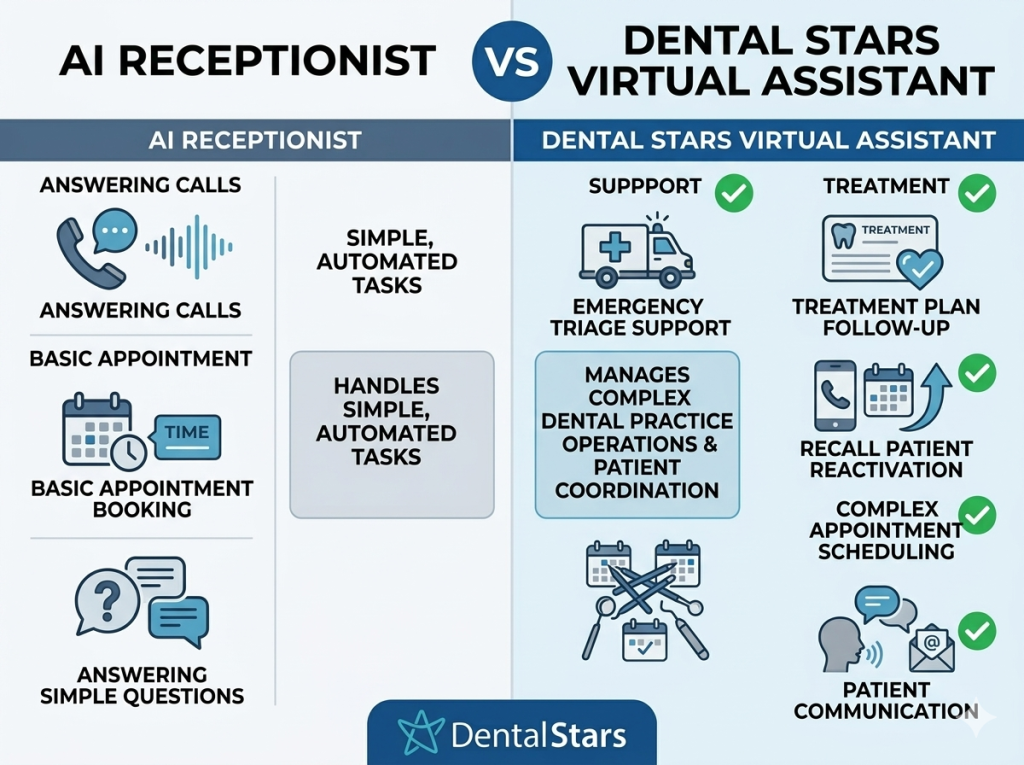
The comparison between an AI receptionist vs virtual receptionist is becoming more common as dental practices explore automation for front desk tasks. AI reception systems promise to answer calls, manage bookings, and reduce pressure on reception teams. However, dental reception work involves much more than answering phones.
In most practices, reception is responsible for patient communication, appointment coordination, recall management, and treatment follow-up. These activities influence patient retention, treatment acceptance, and the overall stability of the appointment book.
While AI tools can assist with simple enquiries and after-hours responses, human receptionists remain far more effective when conversations involve patient understanding, scheduling decisions, and treatment discussions.
This article explains the differences between virtual receptionist AI systems and human reception support, where each approach works best, and how dental practices can evaluate the right solution for their operational needs.
What Is an AI Receptionist?
An AI receptionist is a software system that answers phone calls using automated voice technology and structured workflows.
These systems use speech recognition and programmed responses to handle incoming enquiries. Some AI reception platforms also integrate with scheduling software or messaging systems.
Typical AI receptionist capabilities include:
- answering incoming calls automatically
- responding with scripted information
- routing calls to team members
- collecting messages
- booking simple appointments
AI systems perform best when conversations are predictable.
Examples include:
- practice opening hours
- location or directions
- general appointment availability
However, dental reception conversations rarely follow predictable scripts. Patients often call with questions about symptoms, previous treatment, scheduling constraints, or costs. These conversations require context and judgement that automated systems cannot consistently provide.
What Is a Virtual Receptionist in a Dental Practice?
A virtual receptionist is a real human receptionist who supports the practice remotely.
Instead of working physically at the front desk, the receptionist operates remotely while accessing the practice management software, phone system, and patient records.
In dental practices, virtual receptionists commonly assist with:
- missed call handling
- recall calls
- appointment confirmations
- rebooking cancelled appointments
- following up incomplete treatment plans
- patient care calls
Most dental administrative work is already digital, which means remote reception support can integrate into existing systems without disrupting practice operations.
Many practices rely on additional administrative support because reception teams often juggle multiple responsibilities simultaneously. These include patient arrivals, payments, scheduling adjustments, and phone enquiries.
When these tasks compete for attention, proactive communication such as recall calls and treatment follow-up is often delayed.
Why Dental Reception Is Operationally Complex
Dental reception sits at the centre of the patient journey.
Reception teams coordinate scheduling across clinicians, manage patient expectations, and maintain continuity of care.
Common reception responsibilities include:
- managing appointments across multiple providers
- coordinating cancellations and rescheduling
- maintaining recall systems
- following up incomplete treatment plans
- answering treatment related questions
- responding to urgent patient concerns
Many phone enquiries require the receptionist to review patient records before responding.
For example, a patient may call and say:
“I’m still experiencing sensitivity after my filling.”
Before responding, a receptionist may need to:
- review treatment notes
- check when the procedure occurred
- determine whether symptoms are expected
- decide whether the patient should return sooner
These situations require judgement and context. Automated systems cannot reliably interpret this information.
AI Receptionist vs Virtual Receptionist: Key Differences
| Area | AI Receptionist | Human Virtual Receptionist |
| Call answering | Automated responses | Real conversation |
| Patient understanding | Limited | Can review patient notes |
| Scheduling complexity | Basic booking | Manages multi-provider schedules |
| Treatment discussions | Not suitable | Can support patient decisions |
| Recall follow-up | Ineffective | Personalised communication |
| Patient reassurance | None | Human empathy |
| Adaptability | Scripted responses | Flexible judgement |
The difference becomes clear when reception tasks involve patient relationships and ongoing care communication.
Dental reception is not only about answering calls. It is about keeping patients engaged with the practice.
Where AI Receptionists Can Assist Dental Practices
AI reception systems can still provide useful support when used for appropriate tasks.
After-hours call handling
AI systems can answer calls outside practice hours and provide information such as:
- opening hours
- emergency contact instructions
- directions to the practice
Call routing
Automated systems can route calls when several enquiries arrive at once.
Basic appointment enquiries
For routine hygiene appointments, AI systems may assist if integrated with scheduling software.
Website chat responses
AI chat tools can respond to simple website enquiries.
These situations involve structured information delivery, which automation can manage effectively.
Where Human Receptionists Clearly Outperform AI
Most dental reception work involves patient communication.
Human receptionists perform significantly better when conversations require context and empathy.
Reactivating incomplete treatment plans
Many dental practices hold significant volumes of incomplete treatment plans within their patient database.
Patients delay treatment for reasons such as:
- uncertainty about cost
- scheduling conflicts
- dental anxiety
Reactivating treatment plans requires:
- reviewing patient notes
- understanding previous conversations
- responding to patient concerns
- guiding patients back into care
These conversations require human communication.
Managing recall systems
Recall systems help maintain long term patient engagement.
Patients are typically expected to return for preventive care every six months. However, recall systems often fail because reception teams are managing immediate tasks throughout the day.
A dedicated receptionist can:
- contact overdue patients
- review patient history
- explain the importance of returning
- book appointments immediately
Personal communication significantly improves recall performance.
Recovering missed calls
Many dental practices experience 20 to 40 missed calls each week during busy periods.
These calls may represent:
- new patient enquiries
- urgent dental concerns
- appointment booking requests
When calls go unanswered, patients often contact another practice.
A human receptionist can return these calls quickly and convert enquiries into booked appointments.
Supporting anxious patients
Dental anxiety is common.
Patients frequently call with questions about procedures such as:
- wisdom tooth removal
- root canal treatment
- dental implants
These conversations require reassurance and careful explanation.
Patients rarely feel comfortable discussing treatment concerns with automated systems.
Practice Scenario
Two chair suburban practice
A typical suburban dental practice may experience:
- 30 missed calls each week
- several hundred overdue recall patients
- numerous incomplete treatment plans
The in-practice receptionist may already be managing:
- patient check-ins
- payments and insurance claims
- appointment coordination
- clinician scheduling
Even if AI answers calls, it does not resolve the underlying administrative workload.
Additional human administrative support ensures patient communication tasks are completed consistently.
A Hybrid Reception Model
Some practices adopt a hybrid reception structure.
This combines automated tools with human administrative support.
Example workflow:
AI systems manage:
- after-hours enquiries
- basic information requests
- simple call routing
Human reception support manages:
- recall calls
- missed call follow-up
- treatment plan reactivation
- appointment coordination
This model improves efficiency without weakening the patient relationship.
Operational Considerations for Dental Practices
When evaluating reception technology, practice owners should consider several factors.
Patient expectations
Patients generally expect to speak with a person when discussing healthcare concerns.
Scheduling complexity
Dental scheduling involves multiple clinicians and varying treatment durations.
Privacy obligations
Patient information must be handled according to Australian healthcare privacy requirements. Organisations such as the Australian Health Practitioner Regulation Agency provide regulatory oversight for healthcare professionals.
Administrative capacity
Reception systems should strengthen existing workflows rather than create additional complexity.
Decision Framework for Practice Owners
AI reception systems may be suitable when:
- calls are simple and repetitive
- call volumes are relatively low
- reception workload is manageable
Human reception support is typically more effective when:
- missed calls occur regularly
- recall systems are inconsistent
- incomplete treatment plans require follow-up
- reception staff are already managing multiple responsibilities
The goal is not simply answering calls. The goal is maintaining consistent patient communication and ensuring patients remain engaged with the practice.
When Reception Systems Break Down, Practices Feel It First
Reception systems influence more than call answering. They affect recall performance, treatment acceptance, and daily scheduling stability.
If your reception team is already balancing patient check-ins, payments, insurance queries, and clinician coordination, proactive communication tasks often fall behind. Missed calls, overdue recall lists, and incomplete treatment plans are common symptoms.
Dental Stars supports Australian dental practices by strengthening the systems behind patient communication. This includes recall optimisation, incomplete treatment follow-up, and managing inbound call overflow so your in-practice team can focus on the patients in front of them.
If you would like to understand how your current reception workflow could be improved, you can explore how Dental Stars supports practices:
https://dentalstars.com.au/services/
Learn more about the team and approach:
https://dentalstars.com.au/about-us/
Or arrange a conversation:
https://dentalstars.com.au/book-your-consultation/
FAQs
What is the difference between an AI receptionist and a virtual receptionist?
An AI receptionist is an automated system that answers calls using voice technology and scripted responses. A virtual receptionist is a real person who works remotely and performs reception tasks such as scheduling, patient communication, and treatment follow-up.
Can AI receptionists book dental appointments?
Some AI systems can book simple appointments if integrated with scheduling software. However, dental scheduling often requires reviewing clinician availability, treatment length, and patient records. These situations are typically better managed by a human receptionist.
Are AI receptionists suitable for dental practices?
AI receptionists can assist with tasks such as after-hours enquiries and basic call routing. However, they are less effective when conversations involve treatment questions, scheduling complexity, or patient concerns.
Why do dental practices experience missed calls?
Reception teams often manage multiple responsibilities at once including patient arrivals, payments, scheduling adjustments, and phone enquiries. When several tasks occur simultaneously, incoming calls may go unanswered.
Can AI follow up incomplete dental treatment plans?
AI systems cannot effectively follow up incomplete treatment plans because these conversations require reviewing patient notes and responding to individual concerns.
Do patients prefer AI or human receptionists?
Most patients prefer speaking with a person when discussing healthcare matters. Human receptionists can provide reassurance, answer questions, and adjust communication to the patient’s needs.
How does a virtual receptionist work in a dental practice?
A virtual receptionist works remotely while accessing the practice’s phone system and management software. They can answer calls, schedule appointments, conduct recall calls, and follow up with patients.
Can AI improve reception efficiency?
AI can improve efficiency for repetitive tasks such as routing calls or answering basic questions. However, efficiency gains are limited when conversations require contextual understanding.
Is remote reception support common in dental practices?
Many dental practices use remote administrative support to assist with recall calls, missed calls, and treatment follow-up. This reduces pressure on in-practice reception teams.
What should a practice consider before adopting AI reception?
Practice owners should review call types, scheduling complexity, patient expectations, and reception workload before implementing AI reception systems.
For dental practices, a real virtual receptionist consistently outperforms AI handling recalls, follow-ups, anxious patients, and complex scheduling that no automated system can match.
- ✗ Scripted responses only
- ✗ Cannot review patient notes
- ✗ Fails on complex scheduling
- ✗ No recall follow-up capability
- ✗ Cannot discuss treatment plans
- ✗ No empathy for anxious patients
- ✗ Missed calls still go unanswered
- ✓ Real human conversations
- ✓ Reviews patient notes before responding
- ✓ Manages multi-provider scheduling
- ✓ Dedicated recall & reactivation calls
- ✓ Follows up incomplete treatment plans
- ✓ Empathy for nervous patients
- ✓ Converts missed calls into bookings
Your Practice Needs More
Than a Bot Answering Calls.
Dental Stars provides real virtual receptionists who understand your patients, manage your recalls, and reactivate incomplete treatment plans — the work AI simply cannot do.
Get In Touch
Ready to Upgrade Your Practice's Reception?
Talk to the Dental Stars team about how a real virtual receptionist can reduce missed calls, recover overdue recalls, and keep your appointment book full — without adding to your in-practice workload.