
What Can an Offshore Virtual Assistant Do for a Dental Practice?
Somewhere in your practice right now, a patient who said yes to treatment three weeks ago still hasn’t been called back. A form is being retyped by hand because it came in as a PDF. A voicemail from Tuesday is still sitting there, unheard.
None of that is anyone’s fault. Your front desk is already doing three jobs at once: greeting patients, answering the phone, and trying to keep the admin from piling up behind them.
This is exactly the gap an offshore virtual assistant for a dental practice is built to close. Done properly, it isn’t about replacing your team. It’s about giving them room to actually do their jobs, and giving your patients faster, more consistent service.
Here’s the reframe worth sitting with: you probably don’t have a staffing problem. You have a capacity problem. And those two things need very different fixes.
At Dental Stars, we built our offshore support specifically around dental practices, not general admin work borrowed from another industry. That distinction matters more than most practice owners realise until they’ve tried the alternative.

What an Offshore Virtual Assistant Actually Means in a Dental Context
The phrase gets thrown around loosely, so it’s worth being specific.
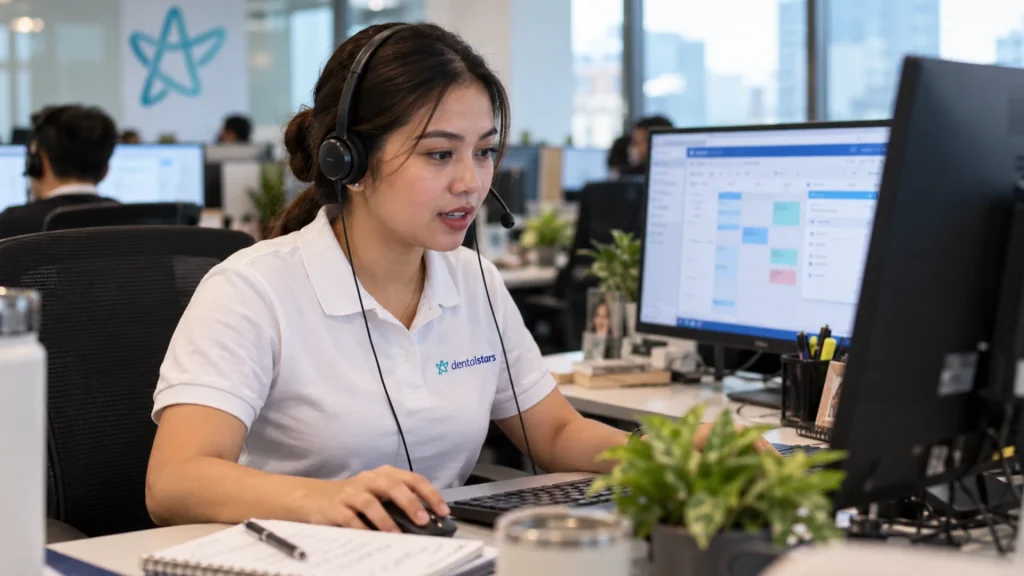
A dental virtual assistant isn’t a call centre reading from a script. They’re not a freelancer juggling five other clients in five other industries. A properly set up offshore assistant works inside your existing systems, understands dental terminology, and follows your practice’s own processes, just from a different location.
They join your team the way a remote staff member would. They use your software, follow your scripts and tone, and report to whoever manages your front desk. The only difference is where they’re sitting.
That distinction is the whole point of dental virtual assistant services done well. A generic assistant can answer a phone. A dental-trained one knows the difference between a routine reschedule and a patient in pain who needs to be seen today.
The Tasks a Dental VA Can Genuinely Take Off Your Plate
This is usually where the real value becomes obvious. A trained offshore assistant can handle:
- Answering and triaging incoming calls, so fewer ring out
- Confirming and rebooking appointments before no-shows happen
- Following up on treatment plans that were accepted but never scheduled
- Reactivating patients who are overdue for recall
- Managing inbox and message follow-up so nothing sits unanswered
- Processing insurance and claims paperwork
- Handling data entry, patient record updates, and general admin backlog
Each of these sounds small on its own. Together, they’re usually where the real revenue leak is hiding.
A missed call isn’t just a missed call. It’s a patient who rings the next practice instead. An unscheduled treatment plan isn’t paperwork sitting in a drawer, it’s dentistry your team already diagnosed that simply never got booked in. An offshore admin assistant working through these consistently, every single day, is often the difference between a book that looks full and a book that actually is full.
What a Dental VA Shouldn’t Be Asked to Do
This part matters just as much, and it’s the part most generic providers skip over.
An offshore assistant, however well trained, is not a clinician. They shouldn’t be making judgment calls on clinical urgency, discussing treatment risk with a worried patient, or handling anything that requires a dentist’s assessment.
Good offshore support knows exactly where that line sits. Their job is to clear the admin path so your clinical team can focus on clinical decisions, not to make those decisions for them. Any provider who blurs that line, or doesn’t have a clear escalation process for it, is a red flag worth taking seriously.
This is also where the difference between real offshore dental admin and a general-purpose virtual assistant becomes obvious. Someone who’s never worked in a dental practice before doesn’t know what needs to be escalated immediately versus what can wait until tomorrow. That judgment only comes from dental-specific training and oversight.
Book your Dental Stars discovery call NOW!Discover How to Unlock Your Practice’s Full Potential
Why “Just Hire a VA” Often Falls Short
Most practices that try this on their own go one of two routes: a freelance platform, or a general virtual assistant agency.
Both can work in theory. In practice, the problems tend to look the same. There’s no dental training, so everything has to be taught from scratch. There’s no ongoing management, so quality drifts once the honeymoon period ends. And when that one assistant leaves, which happens often on freelance platforms, the practice is back to square one with no continuity.
A virtual assistant for dentists should come with the training already built in, along with management, quality checks, and a backup plan if someone’s away. That’s the difference between adding a genuine team member and adding one more thing for your practice manager to babysit.
Get your FREE COPY of The Ultimate "Outsourcing" Task List so you can win back staff time and increase your operational efficiency and profitability.
Get The Ultimate "Offsite" Task List
What It Looks Like When It’s Done Properly
Imagine your phone gets answered on the second ring, every time, without your front desk having to drop what they’re in the middle of. Imagine treatment plans get followed up within 48 hours instead of sitting untouched for a month. Imagine your recall list actually gets worked, week after week, instead of becoming a task nobody has time for.
None of that requires more hours from your existing team. It requires the right support handling the parts of the day that pull them away from patients in front of them.
Is This the Right Fit for Your Practice?
This tends to make the most sense if any of the following sound familiar:
- Your front desk is answering phones while trying to manage patients at the counter
- Treatment plans get accepted but often don’t get scheduled
- Your recall and reactivation list keeps growing instead of shrinking
- Missed calls are a regular occurrence, not an occasional one
- Your team is capable, but stretched too thin to keep up with follow-up
If two or more of these apply, the gap isn’t effort. It’s capacity, and that’s a solvable problem.
Where to Go From Here
An offshore virtual assistant won’t fix a practice with no systems at all. But for a practice with good processes and not enough hands to run them consistently, it’s often one of the fastest, lowest-cost ways to get time and revenue back at the same time, without adding another local hire, another on-cost, or another recruitment headache.
Book your Dental Stars discovery call NOW!Discover How to Unlock Your Practice’s Full Potential
Frequently Asked Questions
Is it compliant to use an offshore virtual assistant in an Australian dental practice?
Yes, provided patient data is handled through secure, compliant systems and the assistant is trained on your privacy obligations. The key is working with a provider who already understands Australian dental compliance requirements, not a generic offshore staffing company.
Will patients know they’re speaking with someone offshore?
Not usually. A well-trained assistant follows your practice’s tone, scripts, and booking systems closely enough that the experience feels consistent with the rest of your team. The goal is continuity, not concealment.
How is a dental-trained offshore assistant different from a general virtual assistant?
A general assistant can handle basic admin, but they won’t know dental terminology, urgency triage, or how treatment follow-up typically works. A dental-trained assistant is set up specifically to understand these things from day one.
What happens to patient data and privacy?
Reputable providers use secure, permission-based access to your existing systems rather than exporting patient data elsewhere. Ask any provider directly how access is controlled and what happens if an assistant leaves.
How long does onboarding usually take?
It varies by practice, but most offshore assistants can be handling core tasks, like calls, confirmations, and follow-up, within the first couple of weeks, with ongoing training as they become familiar with your specific systems and patient base.