
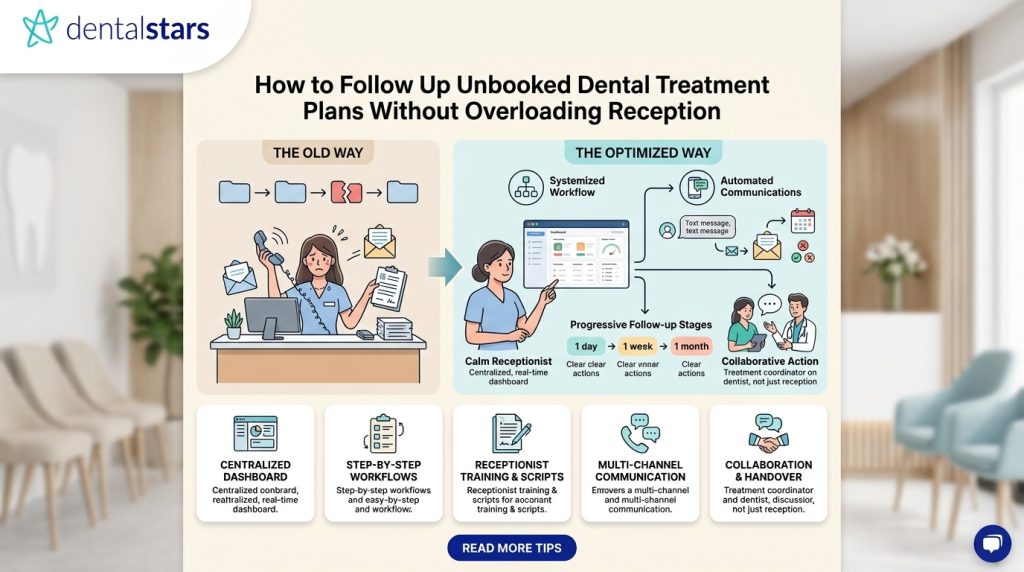
How to Follow Up Unbooked Dental Treatment Plans Without Overloading Reception
Think about every treatment plan presented in your practice last month.
How many patients left without booking their next appointment?
Some may have needed time to consider the cost. Others may have wanted to check their schedule, speak with a family member or think through the recommendation. Some may simply have become distracted by work and family life.
That does not always mean they decided against treatment.
In many cases, the conversation simply stopped.
The patient left the practice, reception moved on to the next person and no one had enough time to reconnect with them. The treatment plan remained in the practice management software while the potential appointment and revenue gradually became less likely.
This is one of the most common revenue leaks in a dental practice.
It is also one of the hardest for reception to manage consistently.
Your front desk is already answering calls, greeting patients, taking payments, managing cancellations, responding to enquiries and keeping the day running. Following up patients who are not currently standing in front of them will almost always be pushed behind more immediate work.
The solution is not asking reception to work faster.
It is giving treatment-plan follow-up a clear process and a dedicated person responsible for completing it.
That is where a Dental Star can help.
A Dental Star can manage the follow-up process on behalf of your practice, helping more patients move forward with recommended care while giving your reception team time back to focus on the patients and responsibilities already in front of them.
The real cost of unbooked treatment plans
One unbooked treatment plan may not seem significant.
Across an entire month or year, however, the value can quickly add up.
Your unbooked list may include:
- Crowns and bridges
- Dental implants
- Orthodontic or clear aligner cases
- Restorative treatment
- Courses of periodontal care
- Multi-appointment treatment plans
- Patients who cancelled before treatment began
- Patients who asked to be contacted at a later date
Each patient has already invested time in attending the practice, discussing their needs and receiving a recommendation.
Your team has also invested time in the examination, diagnosis, treatment planning and presentation.
When no one follows up, that investment may never progress to an appointment.
The effect is not limited to treatment revenue.
Unbooked plans can also result in:
- Lower case acceptance
- Reduced value from your marketing spend
- Patients delaying recommended care
- Inaccurate or outdated follow-up lists
- Additional pressure on reception
- Missed opportunities to answer patient questions
- Patients choosing another practice because they did not hear from yours
The opportunity is often already inside the practice.
The challenge is making sure someone has the time, training and responsibility to act on it.
Book your Dental Stars discovery call NOW!Discover How to Unlock Your Practice’s Full Potential
Why reception follow-up keeps falling behind
Most practices understand that treatment plans should be followed up.
The problem is rarely a lack of awareness.
It is a lack of capacity.
A receptionist may begin the day intending to contact several patients. Then the phone starts ringing, a patient arrives late, an emergency needs to be fitted in and another patient has questions about an account.
The follow-up list is postponed until later.
Later becomes tomorrow, and tomorrow becomes next week.
This happens because treatment-plan follow-up is important but rarely urgent. There is no patient at the desk waiting for the task to be completed, so it continually loses priority to work that requires an immediate response.
This creates a difficult cycle:
- Reception is asked to follow up treatment.
- Immediate front-desk work takes priority.
- Calls and messages are completed inconsistently.
- The list becomes longer and harder to manage.
- Reception feels pressure about work that remains unfinished.
- Practice owners see accepted or proposed treatment sitting unbooked.
The answer is not to place more pressure on the front desk.
The answer is to remove the task from the daily competition for reception’s time.
A practical treatment-plan follow-up process
Effective follow-up does not mean repeatedly chasing every patient with the same message.
It requires a clear, organised and patient-focused process.
1. Build the right follow-up list
The first step is identifying which patients require contact.
The list may include patients who:
- Received a treatment plan but did not make a decision
- Agreed to proceed but did not schedule an appointment
- Needed time to consider costs or payment arrangements
- Asked to be contacted after a certain date
- Cancelled before beginning treatment
- Required another appointment with the dentist before deciding
- Have clinically relevant treatment that remains incomplete.
Each patient should have a clear status so the team knows what has happened and what needs to happen next.
Without this information, patients may be contacted twice, contacted too late or missed entirely.
2. Prioritise the patients who need attention first
Not every treatment plan should be handled in the same order.
A follow-up list can be prioritised according to:
- How recently the plan was presented
- The patient’s clinical needs
- Whether the patient asked to be contacted
- The value and complexity of the treatment
- Whether the patient has already accepted the plan
- How long the treatment has remained unbooked
A patient who agreed to proceed with a significant treatment plan several days ago should not sit in the same queue as someone whose lower-priority treatment was discussed several months ago.
Prioritisation helps the practice focus its time where a timely conversation is most likely to help the patient move forward.
3. Use a consistent contact schedule
Follow-up is more effective when the timing is planned rather than left to memory.
A simple process may include:
- A friendly message within a few working days
- A telephone call for higher-value or more complex treatment
- A second contact after an agreed period if the patient has not replied
- A final outcome recorded in the practice management software
- A future reminder where the patient has requested more time
The timing should follow the practice’s own protocols and the patient’s circumstances.
The purpose is not to pressure the patient. It is to make sure they have not been left with unanswered questions or an unclear next step.
4. Find out what is preventing the patient from proceeding
A treatment-plan follow-up should be a conversation, not a scripted demand to make an appointment.
Patients may be delayed because of:
- Cost
- Appointment timing
- Anxiety about the procedure
- Uncertainty about the recommendation
- Questions about payment options
- Work or family commitments
- A need to speak with the dentist again
- Confusion about what happens next
The person making contact should listen, record the concern and help the patient take the appropriate next step.
Administrative questions may be answered during the conversation. Clinical questions should be referred to the dentist or appropriate clinical team member.
This gives the patient support without placing the person making the call outside their role.
5. Record every outcome and next action
A follow-up process is only useful when the information is kept accurate.
Every contact attempt should record:
- The date and method of contact
- Whether the patient responded
- Questions or concerns raised
- The agreed next step
- Whether an appointment was booked
- When another follow-up is required
- Whether the dentist needs to become involved
This prevents patients from being forgotten or contacted repeatedly without context.
It also gives the practice a clearer view of why treatment remains unbooked and where improvements may be needed.
The process is simple. Consistency is the hard part.
The steps themselves are not complicated.
The challenge is completing them every week while reception continues managing the daily demands of the practice.
This is where many follow-up systems fail.
A spreadsheet may be created. A report may be pulled from the practice management software. Reception may be asked to make calls during quieter periods.
But quieter periods are unpredictable, and the person responsible for follow-up may change from day to day.
Without clear ownership, the process eventually becomes another task everyone knows is important but no one has enough time to complete properly.
A Dental Star gives the process a dedicated owner.
Instead of relying on spare time, your practice has someone responsible for maintaining the list, contacting patients, recording outcomes and keeping the next action moving.
How a Dental Star helps turn plans into appointments
A Dental Star works as an extension of your practice team.
They learn your systems, communication style, booking protocols and escalation process. They then carry out the agreed follow-up workflow without placing the work back on reception.
Depending on your practice’s needs, a Dental Star may:
- Review presented and unbooked treatment reports
- Clean and organise existing follow-up lists
- Prioritise patients according to your protocols
- Send timely messages
- Make follow-up calls
- Answer appropriate administrative questions
- Identify the reason a patient has delayed
- Arrange appointments
- Escalate clinical questions to the practice
- Record all contact and outcomes
- Schedule future follow-up
- Report on appointments and treatment reactivated
This translates into three important business benefits.
1. Recover more potential revenue
Practices often look for growth by attracting more new patients.
New patient marketing is important, but it should not come at the expense of the opportunities already inside the practice.
When a patient has already attended, received a recommendation and shown interest in proceeding, the practice has completed much of the work required to create that opportunity.
A timely follow-up conversation may be what helps the patient take the next step.
A Dental Star helps make sure those opportunities do not disappear because the front desk became occupied with more immediate work.
This may lead to:
- More treatment appointments
- Improved case acceptance
- Faster movement from presentation to booking
- Better use of existing patient demand
- More value from previous marketing activity
- Fewer suitable treatment plans becoming inactive
The goal is not to pressure patients into treatment.
It is to make sure patients who are considering recommended care receive the information, reassurance and next step they need.
2. Give time back to reception
Every follow-up call takes time.
The call itself may only last a few minutes, but the full task includes finding the patient record, reviewing notes, attempting contact, leaving a message, recording the outcome and scheduling another action.
Repeated across dozens of patients, this becomes a significant workload.
When a Dental Star manages the process, reception no longer needs to fit those tasks between incoming calls, check-ins, payments and patient questions.
This gives the front desk more time to:
- Attend to patients in the practice
- Answer new enquiries properly
- Manage the appointment book
- Respond to urgent requests
- Reduce hold times
- Maintain a calmer patient experience
- Complete core responsibilities without carrying an unfinished list
The benefit is not simply completing more calls.
It is removing a recurring source of pressure from the people responsible for keeping the practice running each day.
3. Add support without the usual hiring hassle
Hiring another in-practice team member may involve advertising, interviews, onboarding, training, payroll, equipment and workspace.
There is also no guarantee that the person will understand dental terminology, treatment plans or the sensitivity required when speaking with patients about cost, anxiety and clinical care.
A Dental Star is designed to reduce that burden.
They are:
- Dedicated to your practice
- Trained to work within dental environments
- Integrated into your existing systems
- Guided by your protocols
- Coached and supported
- Monitored through agreed performance measures
- Able to work without requiring another desk inside the practice
You still remain in control of how patients are contacted, what information may be discussed and when an issue should return to the clinical team.
The difference is that you do not need to build the role from the beginning.
Book your Dental Stars discovery call NOW!Discover How to Unlock Your Practice’s Full Potential
Why dental-specific support matters
Treatment-plan follow-up is not the same as making a general sales call.
The person contacting the patient needs to understand that the conversation may involve health concerns, anxiety, finances and treatment that the patient does not fully understand.
They must also know the limits of their role.
A Dental Star can be trained around:
- Common dental terminology
- Practice booking procedures
- Treatment-plan stages
- Patient communication standards
- Privacy requirements
- Payment and appointment information
- When to involve the dentist
- How to document conversations accurately
This makes the interaction feel like it came from the practice rather than from an external call centre reading a script.
The patient receives a consistent experience, while the practice maintains control over the process.
Proof that one conversation can matter
The value of follow-up can be significant.
One Dental Stars client reported reactivating a $30,000 treatment plan following a call from their Dental Star:

Results will differ between practices and patients. However, the example demonstrates why an organised follow-up process matters.
One patient who reconnects with the practice may represent a substantial treatment opportunity.
Across an entire database, the potential effect may be much larger.
Is unbooked treatment costing your practice?
Treatment-plan follow-up may require attention if:
- Presented treatment is sitting unbooked
- Patients are not contacted within an agreed timeframe
- Reception follows up only when the day becomes quiet
- Higher-value treatment is not being prioritised
- Contact attempts are not consistently recorded
- The practice cannot easily see why patients are delaying
- Reception is carrying a growing list of unfinished work
- Marketing continues generating enquiries while existing treatment remains inactive
These are not necessarily signs that the team is performing poorly.
They usually indicate that an important process has been assigned to people who do not have enough protected time to manage it.
Turn follow-up into a reliable part of the practice
You do not need to choose between following up treatment and protecting reception’s time.
With the right process and dedicated support, both are possible.
A Dental Star can take responsibility for maintaining the list, contacting patients, recording outcomes and helping suitable patients return to the appointment book.
For the practice, that means:
- More opportunities to convert existing demand into revenue
- More time returned to the front desk
- Less pressure from unfinished follow-up work
- A clearer and more consistent process
- Support without the usual recruitment and workspace requirements
The patients are already in your database.
The treatment plans have already been discussed.
The next step is making sure the conversation does not stop simply because no one had the time to continue it.
Book your Dental Stars discovery call NOW!Discover How to Unlock Your Practice’s Full Potential
Frequently Asked Questions
What is dental treatment-plan follow-up?
Treatment-plan follow-up is the process of reconnecting with patients who received or accepted a treatment recommendation but have not booked their next appointment.
The purpose is to answer questions, understand what may be preventing the patient from proceeding and help them take an appropriate next step.
How can a practice follow up treatment without overloading reception?
The process needs a clear owner with protected time.
This may mean allocating dedicated internal hours or assigning the work to a Dental Star who can manage the list, contact patients and record outcomes without competing with live front-desk responsibilities.
How often should patients be contacted?
The appropriate timing depends on the treatment, the patient and the practice’s protocols.
A process may include an initial message within several working days, a telephone call for more significant treatment and another follow-up after an agreed period.
Patients who request more time should be contacted according to the date they provide.
Is treatment-plan follow-up pushy?
It should not be.
Good follow-up is helpful, respectful and focused on the patient’s questions. The patient should never feel pressured to accept treatment.
The aim is to prevent someone from being forgotten after receiving a recommendation and to make the next step clear if they wish to proceed.
What happens if a patient asks a clinical question?
Clinical questions should be referred to the dentist or appropriate clinical team member.
A Dental Star can record the question, notify the practice and arrange the next conversation or appointment according to the practice’s process.
Can a Dental Star work inside our existing software?
Yes. A Dental Star can work within the practice’s existing systems and follow its booking, communication and documentation protocols.
This helps the follow-up process become part of the practice’s normal workflow rather than introducing another platform for reception to manage.
How are the results tracked?
Contact attempts, patient responses, appointments and next actions can be recorded within the practice management system or agreed reporting process.
This gives the practice visibility over completed work, appointments generated and common reasons patients are not proceeding.