
Let’s call it what it is.
If your books feel unpredictable…
If your team feels stretched…
If your production fluctuates month to month…
The problem is rarely clinical.
It’s your scheduling system.
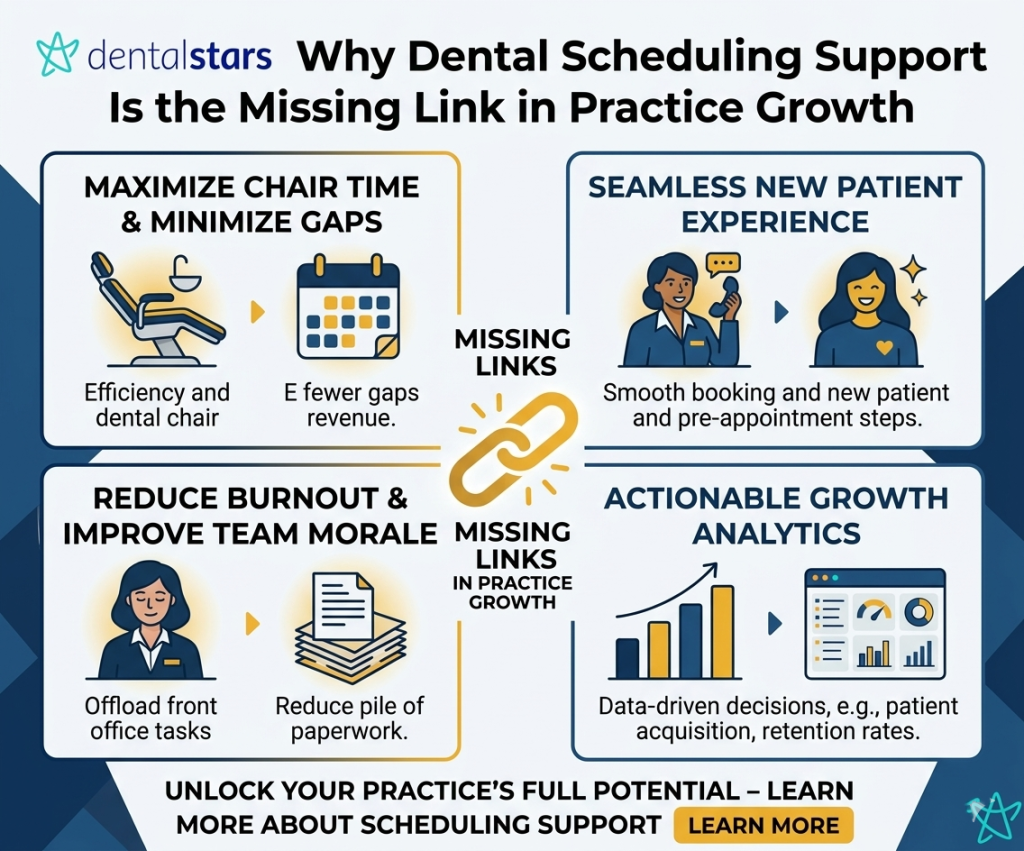
Dental Scheduling Support is not about filling time slots. It is about protecting chair time, activating the value already inside your patient database, and creating production stability you can plan around.
Most practices treat the diary like a calendar.
High-performing practices treat it like a revenue control system.
What Is Dental Scheduling Support?
Dental Scheduling Support is the structured management of:
- Appointment flow
- Recall systems
- Incomplete treatment follow-up
- Failed-to-attend recovery
- Missed call capture
- PMS accuracy and reporting
It ensures:
- The right procedure is booked for the right time
- High-value treatment is prioritised appropriately
- Recalls do not remain untouched
- Incomplete treatment does not stagnate
- Every inbound call is answered and tracked
When implemented correctly, Dental Scheduling Support becomes one of the most powerful operational levers inside a dental practice.
Why Appointment Flow Directly Impacts Revenue
Revenue in a dental practice is tied to one thing:
Chair utilisation.
Yet most revenue leakage occurs quietly through:
- One to two missed calls per day
- Underbooked mornings
- Incomplete treatment worth $500,000+ sitting dormant in the PMS
- Recalls postponed “until there’s time”
- Reception teams constantly reacting instead of controlling flow
In a review of 10 Australian dental practices that believed they “never miss a call,” data showed one to two missed calls per day was common. Some clinics missed 10–20 calls per week.
Research consistently shows that one in three new patients will not call back if their first call goes unanswered.
This is not a scheduling inconvenience.
It is a direct revenue leak.
Dental Scheduling Support closes those leaks systematically.
The Hidden Cost of “Good Enough” Scheduling
Inconsistent scheduling typically presents as:
- Dentists running 15–20 minutes behind daily
- Reception teams overwhelmed by competing priorities
- High-value treatment scattered through low-energy time blocks
- Failed-to-attend rates increasing gradually
- Production spikes followed by unexplained dips
These are not isolated issues.
They are structural symptoms and they are correctable with the right systems.
Real Results From Structured Dental Scheduling Support
Case Study: 50 Additional Bookings Per Month
Coburg Dental Group in Melbourne implemented structured recall, incomplete treatment follow-up and missed call capture.
The result?
50 additional bookings per month.
A dedicated scheduling support team member now completes over 600 outbound recall and reactivation calls monthly and captures approximately 70 inbound calls that would otherwise be missed.
This is not marginal optimisation.
It is measurable, repeatable growth.
$30,000 Reactivated From One Follow-Up Call
At another Australian practice, a single incomplete treatment follow-up resulted in a $30,000 treatment plan being reactivated.
One call.
One system.
One patient who simply needed structured follow-up.
Most practices carry between $500,000 and $1,000,000 in incomplete treatment inside their PMS.
Dental Scheduling Support converts dormant data into booked production.
Why PMS Software Alone Won’t Fix Scheduling
Practice Management Software is a tool.
It is not a system.
Common issues observed across Australian dental practices include:
- Inconsistent procedure coding
- Guess-based time allocations
- Poor recall tagging
- No routine reporting review
- No clear ownership of recall lists
Effective Dental Scheduling Support requires:
- Defined appointment categories
- Standardised time blocks
- Protected high-value production windows
- Clear emergency buffers
- Structured recall cycles
- Weekly reporting review
Technology supports visibility.
Structure drives results.
Core Components of Effective Dental Scheduling Support
1. Recall Optimisation
- Daily outbound recall activity
- Reactivation of lapsed patients
- Structured follow-up cycles
- Multi-channel reminder systems
2. Incomplete Treatment Management
- Prioritised follow-up based on value and urgency
- Value-based communication scripting
- Consistent outreach cadence
- Conversion tracking
3. Missed Call Capture
- Inbound overflow coverage
- Real-time call handling
- Elimination of voicemail gaps
4. Failed-to-Attend Recovery
- Same-day follow-up protocols
- Clear rebooking pathways
- Pattern identification and tracking
5. Diary Segmentation
- High-value procedures booked in peak focus hours
- Protected production blocks
- Controlled emergency allocation
This is Dental Scheduling Support implemented correctly.
In-House vs Structured Scheduling Support
Many practice owners assume more reception staff is the solution.
The real question is not capacity.
It is structure.
In-House Challenges
- Roster dependency
- Reactive workloads
- Training inconsistency
- Sick leave disruption
- Ongoing recruitment cycles
Structured Dental Scheduling Support
- Dedicated scheduling focus
- Standardised scripts and workflows
- Consistent daily recall activity
- Measured KPIs
- Clear production visibility
Many practices adopt hybrid models, keeping core reception in-house while using structured external scheduling support to stabilise recall, follow-up and call handling.
Early Warning Signs You Need Dental Scheduling Support
If three or more of the following apply, your scheduling system requires attention:
- Books feel busy but production fluctuates
- Recalls remain untouched
- Incomplete treatment exceeds $500,000
- Dentists consistently run behind
- Morning sessions are underbooked
- Five to ten calls missed weekly
- Reception is constantly firefighting
- Failed-to-attend rates are increasing
These are not people problems.
They are system problems.
The ROI of Structured Dental Scheduling Support
Consider conservative numbers:
- 40 additional appointments per month at $350 = $168,000 per year
- 10 recovered missed calls per month = $42,000 per year
Even modest improvements deliver significant stability.
When scheduling becomes predictable, stress reduces across the entire team.
Compliance and Governance Considerations
Scheduling directly impacts:
- Documentation accuracy
- CDBS eligibility verification
- Billing integrity
- Treatment continuity
Structured Dental Scheduling Support strengthens clinical governance by ensuring follow-up pathways are consistent, documented and accountable.
The Bigger Picture: Stability Over Chaos
When scheduling remains informal:
- Revenue volatility increases
- Staff fatigue escalates
- Patient retention declines
- Growth stalls
When scheduling is structured:
- Production becomes predictable
- Incomplete treatment converts
- Recalls operate consistently
- Missed calls disappear
- Teams regain control
Dental Scheduling Support is not administrative overhead.
It is operational infrastructure.
Ready to Stabilise Your Production?
If your books feel unpredictable…
If recalls are inconsistent…
If incomplete treatment is sitting untouched…
It’s time to stop treating scheduling like admin and start treating it like strategy.
Book a free strategy call (a Scheduling Performance Review) and we’ll:
- Identify hidden revenue inside your current schedule
- Analyse your recall and incomplete treatment data
- Show you exactly where chair time is being lost
- Map out a structured Dental Scheduling Support plan tailored to your practice
👉 Book your free strategy call here → https://dentalstars.com.au/book-your-consultation/
No obligation just a practical review to help you understand where scheduling can be strengthened.
Let’s turn your diary into a growth engine.
Conclusion: Treat Scheduling as Strategy
Dental Scheduling Support is not diary management.
It is a strategic growth system.
Practices that prioritise scheduling experience:
- Stable production
- Reduced staff stress
- Higher treatment completion
- Stronger patient continuity
Those that rely on informal systems experience volatility and burnout.
The difference is structure.
And structure scales.
Turn Your Schedule Into a Predictable Growth Engine
If your diary feels full but production still fluctuates, the issue is rarely clinical. It is almost always structural.
Most practices already have the patients, the treatment plans, and the demand. What they lack is a structured system to convert that opportunity into booked production.
Dental Scheduling Support helps you:
• Recover missed calls before they become lost patients
• Reactivate incomplete treatment sitting inside your PMS
• Stabilise recall systems and reduce failed appointments
• Protect high value chair time so production becomes predictable
The result is not just a busier schedule.
It is a controlled, revenue aligned diary that supports sustainable growth.
If you want to see where hidden production is sitting inside your schedule, the first step is a Scheduling Performance Review.
During this consultation we will:
-
Analyse where chair time is being lost
-
Identify dormant treatment opportunities in your database
-
Review recall and follow up performance
-
Map a structured scheduling strategy tailored to your practice
Book Your Free Scheduling Performance Review
What Happens Next
Once booked, we will review your current scheduling performance and show you exactly where improvements can be made. There is no obligation. Just a practical review designed to help you stabilise production and take control of your schedule.
Your diary should not feel unpredictable.
With the right structure, it becomes one of the most powerful growth systems in your practice.
FAQs
What does dental scheduling support include?
Dental Scheduling Support includes recall management, incomplete treatment follow-up, missed call capture, diary segmentation, failed-to-attend recovery and structured PMS reporting.
How does dental scheduling support increase revenue?
It improves chair utilisation, reactivates incomplete treatment, captures missed calls and stabilises recall systems, directly increasing booked production.
Can PMS software solve scheduling issues?
No. PMS supports visibility. Without defined processes and accountability, inefficiencies persist.
Should small dental practices use dental scheduling support?
Yes. Small practices benefit significantly when administrative demand exceeds in-house capacity, particularly for recall and incomplete treatment follow-up.
How often should scheduling systems be reviewed?
Quarterly reviews of recall performance, cancellation patterns and production data are recommended.