
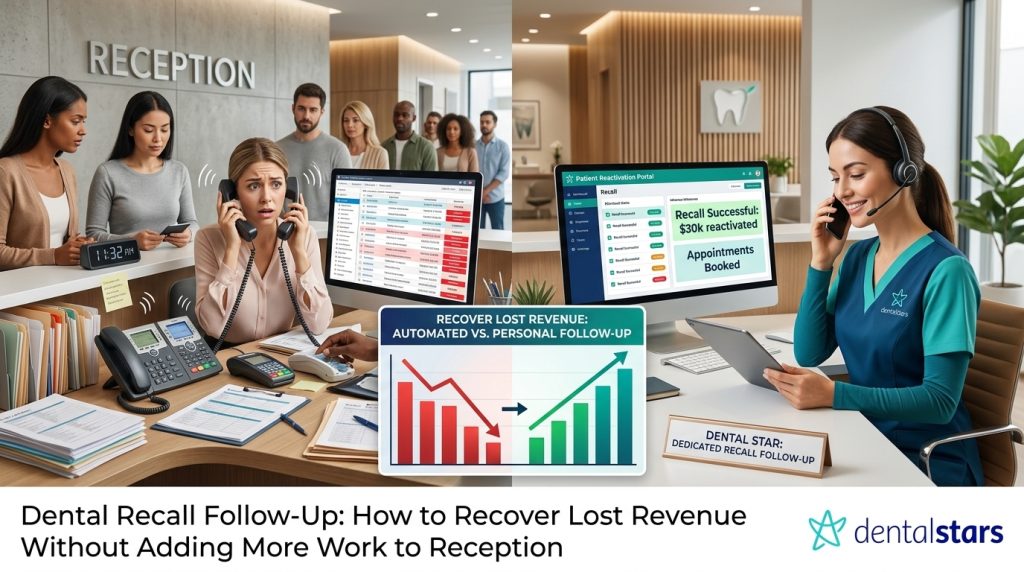
Dental Recall Follow-Up: How to Recover Lost Revenue Without Adding More Work to Reception
Open your practice management software and look at the number of patients who are due or overdue for their next visit.
How many have been contacted?
How many received one automated reminder but no personal follow-up?
How many have moved from a few weeks overdue to six months, twelve months or longer?
Every patient on that list represents an opportunity to protect their oral health, retain an existing relationship and bring appropriate appointments back into your book.
Yet recall is also one of the easiest responsibilities for a busy dental practice to neglect.
It is not because reception does not understand its importance.
Your front desk is already answering incoming calls, welcoming patients, managing the appointment book, taking payments, filling cancellations and helping clinicians keep the day moving.
Recall matters, but it rarely demands an immediate response.
That is why it is repeatedly left until the practice becomes quieter.
The problem is that the quiet period usually never arrives.
A reliable recall system does not depend on spare time. It gives the work a clear process, protected time and someone who is accountable for completing it.
For many practices, that person is a dedicated Dental Star.
A Dental Star can work through your recall list consistently, reconnect with patients and record every outcome while your front-desk team remains focused on the patients and enquiries that need their attention now.
The result is more potential revenue from your existing database, less pressure on reception and additional capacity without the usual hassle of hiring another person inside the practice.
Why dental recall follow-up keeps falling behind
Consider what a receptionist may need to manage during an ordinary hour:
- Patients arriving and checking out
- Incoming telephone calls
- Appointment changes
- Payments and account questions
- Urgent treatment enquiries
- Clinician requests
- Laboratory deliveries
- Cancellations that need to be filled
- New patient enquiries that require immediate attention
An overdue patient who is not currently contacting the practice cannot compete with those responsibilities.
Reception may intend to work through the list after lunch or toward the end of the day. Then the afternoon becomes busy, another team member needs help or the appointment book changes.
The recall work moves to tomorrow.
This is not a motivation problem. It is a capacity problem.
When recall depends on whoever has a spare moment, contact becomes inconsistent. One patient may receive several reminders while another receives none. Notes may not be updated, promised calls may be forgotten and the overdue list continues growing.
Eventually, the list becomes so large that the team does not know where to begin.
What an unmanaged recall list costs the practice
A recall list is not simply an administrative report.
It affects patient retention, appointment-book stability, treatment opportunities and the value the practice receives from its marketing.
Appointments remain unfilled
Patients who would have returned with a timely reminder may continue delaying their visit.
Across dozens or hundreds of overdue patients, those missing appointments can create avoidable gaps in the book.
A consistent recall process helps the practice generate appointments from people who already know the practice, rather than relying entirely on new patient acquisition.
Recommended care may be delayed
Routine visits create opportunities to review a patient’s oral health and identify changes that may require attention.
When patients remain overdue, necessary conversations and treatment planning may also be delayed.
Recall is therefore not simply about filling the appointment book. It helps patients return for appropriate ongoing care.
Existing patients may gradually disengage
Patients do not always make a deliberate decision to leave their dentist.
They become busy, forget to book or continue postponing the appointment because no one follows up.
As more time passes, the relationship weakens. When they eventually need care, they may search online and contact whichever practice appears first or responds fastest.
Marketing becomes less efficient
Practices often invest heavily in attracting new patients while existing patients become inactive.
New patient marketing remains important, but it becomes more expensive when the practice must continually replace patients it could have retained through better follow-up.
A stronger recall system helps protect the value of the patient relationships the practice has already invested in building.
Reception carries unfinished work
An overdue list creates an ongoing mental burden for the front desk.
The team knows the calls should be made, but immediate responsibilities continue taking priority. This creates pressure without giving the team the time required to solve the problem.
Removing recall from the daily competition for reception’s attention gives the practice a more dependable process and gives the front desk one less unfinished responsibility to carry.
Book your Dental Stars discovery call NOW!Discover How to Unlock Your Practice’s Full Potential
What a reliable dental recall system should include
A good recall system is more than sending the same automated message to every overdue patient.
It should identify who needs contact, determine who should be contacted first, use an appropriate follow-up sequence and record what happens after each conversation.
1. Create an accurate recall list
The first step is making sure the data is correct.
The list should distinguish between patients who:
- Are approaching their recommended recall date
- Have recently become overdue
- Are several months overdue
- Have repeatedly failed to respond
- Asked to be contacted at a later date
- Already have an appointment
- Have transferred or should no longer be contacted
- Require review by the clinical team before another appointment is arranged
Working from clean information prevents unnecessary messages and helps the practice focus on patients who genuinely require follow-up.
2. Prioritise the list
Not every patient needs the same contact at the same time.
A practice may prioritise patients according to:
- How overdue they are
- The clinician’s recommended review period
- Their previous appointment history
- Whether they have outstanding or incomplete treatment
- Whether they requested a future call
- Available appointments the practice needs to fill
- Any instructions recorded by the clinical team
This helps the person responsible for recall direct their time toward the patients most likely to benefit from prompt contact.
3. Use more than one contact method
Automated reminders are useful, but they are not a complete recall strategy.
Patients may ignore an automated message, change their telephone number or intend to respond later and forget.
A sequence may include:
- An initial text message or email
- A second reminder after an appropriate period
- A personal telephone call
- A voicemail or follow-up message when the patient cannot be reached
- A future task when the patient asks to be contacted later
The exact timing should follow the practice’s protocols and the patient’s circumstances.
4. Make the conversation helpful
A recall call should not sound like a demand to book.
The purpose is to reconnect with the patient, remind them they are due and make it easier to arrange the next step.
The patient may be delayed because:
- They have forgotten
- Their preferred appointment time was unavailable
- Work or family commitments have changed
- They are concerned about cost
- They feel anxious about returning
- They believe they do not need an appointment
- They have moved or changed practices
- They have a question that should be referred to the clinical team
Understanding the reason allows the practice to respond appropriately rather than sending repeated generic reminders.
5. Record every outcome
Every attempt should result in a clear status.
The record may include:
- When the patient was contacted
- Which contact method was used
- Whether they responded
- The reason they have not booked
- Whether an appointment was arranged
- When the next follow-up should occur
- Whether the matter needs to return to reception or the clinical team
- Whether the patient should be removed from the active recall list
This prevents duplicated work and gives the practice a clearer picture of how its recall system is performing.
Why even a good system fails without enough capacity
A practice can have the right reports, reminders and scripts and still struggle with recall.
The process only works when someone consistently completes it.
Reception may manage the list successfully during a quiet week. When the practice becomes busy again, recall returns to the bottom of the priority list.
That inconsistency is what allows patients to remain overdue.
The practice does not necessarily need a more complicated system.
It needs someone with enough protected time to run the existing system properly.
How a Dental Star manages recall for your practice
A Dental Star becomes a dedicated extension of your practice team.
They work within your systems, follow your communication standards and use the recall process agreed with your practice.
Their work may include:
- Reviewing due and overdue patient reports
- Cleaning and organising the recall list
- Identifying patients who require priority contact
- Sending reminders
- Making personal follow-up calls
- Listening to the reason a patient has delayed
- Arranging suitable appointments
- Escalating clinical questions
- Updating patient records
- Scheduling future contact
- Reporting on conversations and appointments booked
Instead of recall being added to the front desk’s existing workload, it becomes a defined responsibility with a clear owner.
That creates three main benefits for the practice.
More potential revenue from patients you already have
Growing a practice does not always require generating more leads.
There may already be considerable opportunity within the existing patient database.
A patient who knows the practice and has attended previously is generally further along the decision process than someone encountering the practice for the first time.
Consistent recall follow-up can help:
- Bring appropriate patients back into the appointment book
- Reduce avoidable gaps
- Improve patient retention
- Create opportunities for clinically appropriate treatment discussions
- Make better use of previous marketing and patient acquisition costs
- Support steadier appointment demand
No follow-up process can guarantee that every patient will return.
It can, however, prevent patients from being lost simply because no one had enough time to contact them.
More time for your front-desk team
Recall work involves more than making a quick call.
The team member must review the record, check previous notes, make contact, respond to questions, arrange an appointment, document the conversation and schedule another action when necessary.
Multiplied across a large overdue list, this becomes hours of recurring work.
When a Dental Star takes responsibility for recall, the front desk can spend more time:
- Responding properly to incoming enquiries
- Helping patients already inside the practice
- Managing the appointment book
- Filling urgent cancellations
- Processing payments
- Supporting the clinicians
- Maintaining a calmer and more organised patient experience
The practice is not merely outsourcing telephone calls.
It is protecting the time of the people responsible for managing the live demands of the day.
Additional support without another in-practice hire
Recruiting another local team member may involve:
- Advertising the position
- Reviewing applications
- Conducting interviews
- Onboarding and training
- Payroll, superannuation and leave
- Providing equipment and workspace
- Managing ongoing performance
- Repeating the process when the person leaves
A Dental Star provides dedicated administrative capacity without requiring another desk inside the practice.
Your Dental Star is supported, coached and integrated into the systems and protocols you already use.
You remain responsible for approving the workflow, communication standards and escalation rules. Dental Stars provides the person and ongoing support required to carry out the work consistently.
Book your Dental Stars discovery call NOW!Discover How to Unlock Your Practice’s Full Potential
Why dental-specific support matters
Recall conversations may involve more than finding an appointment time.
Patients may mention outstanding treatment, dental anxiety, concerns about cost or questions about why another visit is required.
The person contacting them must know how to listen, what information they can provide and when the conversation should return to the practice.
A Dental Star can be trained in:
- Dental terminology
- Recall and reactivation workflows
- Appointment types and booking rules
- Patient communication
- Practice management software
- Privacy and documentation requirements
- Escalation procedures
- The tone and standards of your practice
This provides a different experience from a generic caller working from a list.
The aim is for the patient to feel that they are speaking with a genuine member of your practice team.
The value of consistent patient follow-up
One Dental Stars client reported that a follow-up call helped reactivate a $30,000 treatment plan:
“I highly recommend Dental Stars. I’ve recently had a $30k treatment plan reactivated based on a call from Will. The results speak for themselves.”
Dr Jeffrey Kestenberg, Coburg Dental Group
This example relates to treatment-plan follow-up rather than a routine recall appointment, and individual results will vary.
However, it demonstrates the broader value of having someone consistently working through the patients and opportunities already recorded in the practice database.
The opportunity was already there.
What was missing was someone with the time to continue the conversation.
Recall may not be the only work being left behind
Once a practice reviews its recall process, it often discovers the same capacity problem in other parts of the patient journey.
A Dental Star can also help with:
Missed calls and new enquiries
When an incoming call is missed or an online enquiry receives a slow response, a potential patient may contact another practice.
A Dental Star can help return missed calls, respond to enquiries and continue following up until there is a clear outcome.
Unbooked treatment plans
Patients may receive a recommendation but leave without booking because they need time, have questions or want to review their finances.
A Dental Star can follow the practice’s treatment-plan process, identify what is preventing the patient from proceeding and arrange the appropriate next step.
Cancellations and no-shows
Last-minute gaps affect production and disrupt the day.
A Dental Star can contact suitable patients, work through short-notice lists and follow up people who cancelled without rescheduling.
Overdue accounts and payment reminders
Payment follow-up can be uncomfortable and time-consuming for reception.
A Dental Star can send agreed reminders, document responses and refer complex matters back to the practice.
Practice management system updates
Incomplete notes, outdated patient details and inconsistent statuses make every follow-up process harder.
A Dental Star can help maintain cleaner records and reduce the administrative work that gradually accumulates.
Reviews and patient communication
Depending on the support your practice needs, Dental Stars can also assist with review responses, newsletters, social media administration and other recurring patient communication tasks.
The purpose is not to transfer random tasks to another person.
It is to identify the repetitive work consuming your team’s time or being left unfinished and give it a trained, accountable owner.
Is your current recall system working?
Ask the following questions:
- Do you know exactly how many patients are currently overdue?
- Is the list accurate and prioritised?
- Does one person clearly own the process?
- Are patients contacted through more than one channel?
- Does recall continue during busy weeks?
- Is every response and next action recorded?
- Can you see how many appointments have resulted from follow-up?
- Is reception still trying to fit recall between live front-desk responsibilities?
- Are missed calls, treatment follow-up or cancellations also being neglected?
A “no” to several of these questions does not mean your team is failing.
It usually means the practice has more recurring administrative work than the existing team has capacity to complete.
Turn your overdue list into a working patient-retention system
Patients do not always leave because they were unhappy with the practice.
Sometimes they simply became busy, forgot to book or continued postponing an appointment because no one reconnected with them personally.
A proper recall system helps prevent those relationships from disappearing.
A dedicated Dental Star can give recall the time and attention it requires while also helping your practice:
- Recover more potential revenue from its existing database
- Return time to reception
- Reduce the pressure created by unfinished tasks
- Improve the consistency of patient communication
- Add administrative capacity without another in-practice hire
- Address other gaps across the patient journey
You may not need to spend more money attracting patients before looking at the opportunities already inside your practice.
You may need someone who has the time to follow them up properly.
Book your Dental Stars discovery call NOW!Discover How to Unlock Your Practice’s Full Potential
Frequently Asked Questions
What is dental recall follow-up?
Dental recall follow-up is the process of contacting patients who are approaching or have passed their recommended review date and helping them arrange an appropriate appointment.
It may involve automated reminders, personal calls, future follow-up tasks and accurate documentation of each outcome.
Why does reception struggle to complete recall?
Recall competes with patients at the desk, incoming calls, payments, appointment changes and urgent requests.
Because overdue patients do not usually require an immediate response, their follow-up is repeatedly postponed. This is generally a capacity issue rather than a lack of effort.
How often should overdue patients be contacted?
The timing should reflect the practice’s clinical recommendations, communication policy and the patient’s circumstances.
A typical process may use an initial reminder, another message after an agreed period and a personal call when the patient has not responded.
The practice should also have clear rules about when to pause contact, schedule a future reminder or remove someone from the active list.
Can a Dental Star work in our practice management software?
A Dental Star can work within the practice’s existing systems and follow its approved workflows, booking protocols and documentation standards.
This allows recall activity and patient responses to remain visible to the practice team.
What happens when a patient asks a clinical question?
The Dental Star should record the question and refer it to the appropriate clinician or team member.
They should not provide clinical advice or alter a treatment recommendation.
How do we know whether the service is producing results?
The practice can track measures such as:
- Patients contacted
- Responses received
- Appointments booked
- Future contact dates arranged
- Patient records updated
- Common reasons patients are not returning
- Other follow-up opportunities identified
The agreed reporting should focus on both completed activity and meaningful outcomes.
Can a Dental Star perform work other than recall?
Yes. Depending on the role created for your practice, a Dental Star may also help with missed calls, new patient enquiries, unbooked treatment, cancellations, payment reminders, patient reactivation, software updates and other recurring administrative work.
The responsibilities should be clearly defined so the Dental Star can become accountable for the agreed outcomes.