
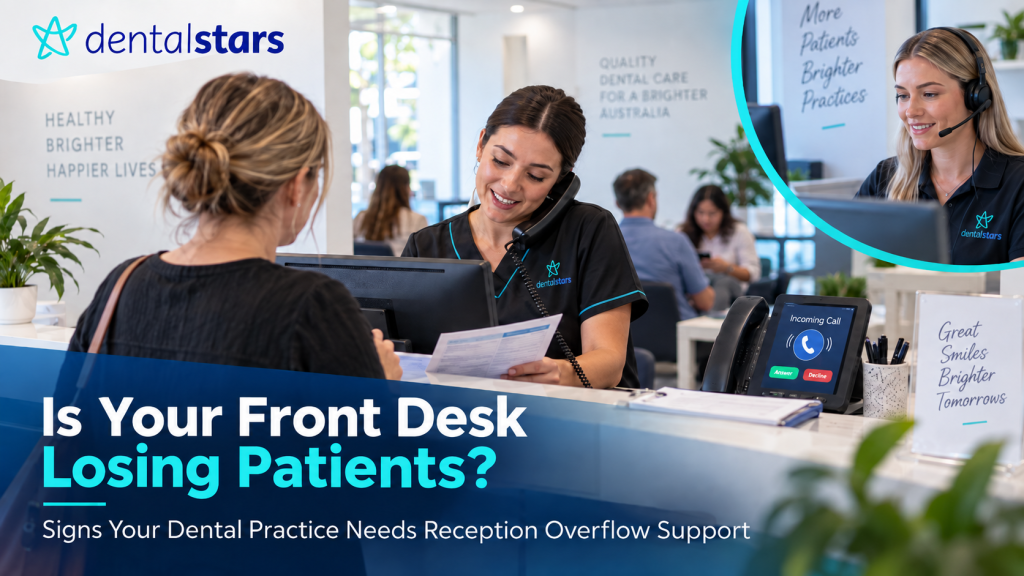
Is Your Front Desk Losing Patients? Signs Your Dental Practice Needs Reception Overflow Support
It is Monday lunchtime. Two patients are waiting to check out, one caller is on hold, a clinician needs help, and the phone begins ringing again.
Your receptionist sees the call but cannot answer without leaving the patients in front of them waiting. By the time the team returns it, the caller has already booked elsewhere.
This is not poor service or a lack of effort. It is what happens when more work reaches the front desk than one person can reasonably manage at once.
Every missed call, delayed reply and unfinished follow-up creates an opportunity for a patient to leave. It can also reduce appointment numbers, weaken the return from your marketing and place more pressure on an already stretched team.
Dental reception overflow support gives your practice additional capacity when the front desk cannot keep up. A dedicated Dental Star can answer enquiries, book appointments and complete agreed follow-up inside your systems while your in-practice team focuses on the patients in front of them.
The result is more opportunities converted into revenue, more time returned to reception and extra support without the usual recruitment and management hassle.
Signs your front desk needs support
Reception overload rarely begins with one major failure. It usually appears as several smaller problems that gradually become normal.
1. Calls regularly ring out
A few missed calls may not seem serious, but the number can rise quickly during lunch, before work, after school and at the end of the day.
Some callers will leave a message. Many will not. A patient with a toothache or someone ready to book a consultation may simply call the next practice in the search results.
2. Patients say they could not get through
When patients mention repeated calls, long hold times or unanswered messages, the capacity problem is already affecting their experience.
An existing patient may remain with the practice, but the inconvenience reduces confidence. For a new enquiry, it may end the relationship before it begins.
3. Service at the desk feels rushed
A receptionist cannot give full attention to a patient while answering another call, processing a payment and responding to a clinician at the same time.
4. Follow-up keeps moving to tomorrow
Recall, missed-call follow-up and unbooked treatment rarely feel as urgent as a ringing phone or a patient at the counter. They are completed only when the day becomes quiet, and in many practices that quiet period never arrives.
The result is a growing list of patients who intended to book, were due to return or needed another conversation but heard nothing from the practice.
5. Your strongest receptionist is exhausted
A reliable team member may absorb extra work for months before the problem becomes obvious. They work through lunch, stay late and carry unfinished tasks into the next day.
Constant interruption increases stress and creates more opportunities for mistakes. The practice may eventually lose an experienced receptionist and face the cost of recruiting and training a replacement.
Book your Dental Stars discovery call NOW!Discover How to Unlock Your Practice’s Full Potential
What reception overload really costs
A new patient may need emergency care, a comprehensive examination or a consultation for higher-value treatment. When the enquiry is missed, the practice can lose both the first appointment and the longer patient relationship that may have followed.
Existing patients are affected too. Calls about treatment, recalls, cancellations and account questions can remain unanswered. The longer a patient waits, the easier it becomes to delay treatment, forget to rebook or contact another practice.
Overload also reduces the return from marketing. The practice pays to generate enquiries and then pays again to replace the opportunities it could not handle.
The hidden cost is team pressure. Every call interrupts another task. Work takes longer, follow-up accumulates and reception finishes the day knowing important jobs remain incomplete.
How reception overflow support works
Overflow support should do more than take a message and send it back to your team.
A dedicated Dental Star learns your services, appointment types, communication style, booking rules and escalation procedures. They can then work within your practice management software as an extension of the team.
Depending on the role created for your practice, a Dental Star may:
- Answer incoming calls during agreed coverage periods
- Respond to new-patient enquiries
- Book, move and confirm appointments
- Return missed calls promptly
- Fill short-notice cancellations
- Update patient details and notes
- Follow approved scripts and booking protocols
- Escalate clinical questions appropriately
- Record outcomes for the in-practice team
The caller receives help rather than a message, and reception avoids handling the same enquiry twice.
Three business benefits
More revenue from existing demand
When more enquiries are answered and followed up, more suitable patients have the opportunity to book. When cancellations are worked quickly, gaps can be offered to patients ready to attend.
No service can guarantee that every call becomes an appointment. The aim is to stop losing viable opportunities simply because reception was occupied.
More time for your in-practice team
A receptionist helping someone at the desk must stop, change context, handle the caller, update the system and then return to the original task.
Overflow support removes part of that cycle. The in-practice team can focus on arrivals, departures, payments and immediate patient needs while the Dental Star manages agreed calls and administration.
This creates a calmer front desk and fewer unfinished tasks.
More capacity with less hiring hassle
An in-house hire involves advertising, interviews, onboarding, payroll, superannuation, leave, equipment, workspace and ongoing performance management.
Dental Stars handles recruitment, initial training, coaching and support. Your practice still sets the standards and approves the workflow, but it does not need to build the role alone.
Book your Dental Stars discovery call NOW!Discover How to Unlock Your Practice’s Full Potential
Why a Dental Star is different
An answering service generally collects a name, number and message. The work then returns to your team.
A Dental Star is intended to complete agreed tasks. They can speak with the patient, follow your booking rules, enter the appointment in your software and record the outcome.
Dental-specific training also matters. Patient conversations may involve treatment names, appointment sequencing, anxiety, costs and questions that must be escalated correctly. The person needs to understand what they can handle and what must return to the clinical team.
A dedicated Dental Star becomes familiar with your practice rather than handling calls for many unrelated businesses. That consistency helps the service feel like part of your team.
One conversation can be worth more than the call
Coburg Dental Group reported that a follow-up call from its Dental Star helped reactivate a $30,000 treatment plan.
Dr Jeffrey Kestenberg said: “I highly recommend Dental Stars. I’ve recently had a $30k treatment plan reactivated based on a call from Will. The results speak for themselves.”
This was a treatment follow-up result, and outcomes differ between practices. It shows the value of giving patient communication a clear owner.
The opportunity already existed. What was missing was consistent follow-up.
Go beyond call overflow
Reception overflow may be the first problem you notice, but it is often part of a wider capacity gap.
A Dental Star can also help manage recurring work that affects revenue and patient retention:
Recall and reactivation: Contact due and overdue patients, record responses and arrange appointments or future follow-up.
Unbooked treatment: Reconnect with patients who received a treatment plan, help with administrative questions and refer clinical concerns to the dentist.
Cancellations and no-shows: Offer short-notice gaps to suitable patients and contact people who cancelled without rebooking.
Payment reminders: Send approved reminders, document responses and return complex account matters to the practice.
Database and communication support: Update records and assist with approved review responses, newsletters, data entry and other recurring administration.
The purpose is not to hand over random jobs. It is to identify repetitive work affecting revenue or consuming reception time and give it a trained, accountable owner.
Is overflow support right for your practice?
It may be time to add support when calls are regularly missed, patients struggle to get through, new enquiries wait too long, recalls and treatment follow-up remain unfinished, cancellations create avoidable gaps, or your receptionist is showing signs of sustained overload.
These signs do not mean your team is failing. They mean the workload has exceeded the time available.
Your receptionist should not have to choose between the patient standing at the desk and the patient calling to book.
With a dedicated Dental Star, the practice can answer more enquiries, manage bookings and keep important follow-up moving without placing another layer of work on reception each day.
That means more opportunities converted into appointments, more time returned to the in-practice team and additional support without the usual recruitment and management burden.
Book your Dental Stars discovery call NOW!Discover How to Unlock Your Practice’s Full Potential
Frequently Asked Questions
What is dental reception support?
Dental reception support provides additional administrative capacity for calls, enquiries, bookings and follow-up work.
A dedicated Dental Star works according to the processes and responsibilities agreed with the practice.
Is reception support the same as an answering service?
No. An answering service generally records and forwards a message.
A Dental Star can complete approved next steps, such as arranging appointments, updating records and following up the patient, rather than returning the work to reception.
Can a Dental Star work in our practice management software?
A Dental Star can be trained to work within the systems and workflows approved by the practice.
Their access, responsibilities and escalation procedures should be clearly defined during setup.
Can a Dental Star answer clinical questions?
A Dental Star should not provide clinical advice.
They can record the patient’s question and refer it to the appropriate clinician or team member.
Will the Dental Star only answer calls?
The role can include more than telephone coverage.
Depending on the practice’s needs, a Dental Star may assist with missed calls, new patient enquiries, recalls, treatment follow-up, cancellations, payment reminders, system updates and other recurring administrative tasks.
How do we measure the results?
Relevant measures may include:
- Calls answered
- Missed calls returned
- Enquiries contacted
- Appointments booked
- Cancellations rescheduled
- Recall appointments arranged
- Treatment follow-up outcomes
- Response times
- Administrative tasks completed
- Hours of work removed from reception
The practice should agree on the measures that reflect the responsibilities assigned to the Dental Star.